

Soap Packaging
FAQ'sSpecifications Description Reviews |
|
Q:
What materials work best for soap packaging?A:
Kraft paperboard, coated cardstock, and rigid board are the most common soap packaging materials. Kraft suits natural, handmade lines, while coated stock with an oil- and moisture-resistant laminate protects premium bars from stains and humidity without compromising print clarity or shelf presentation. Q:
How do I get an accurate soap box dieline?A:
We provide a free dieline template scaled to your exact box dimensions before you start designing. It marks fold lines, bleed, and safety margins clearly, so your logo, text, and graphics don't get trimmed, distorted, or hidden inside a glued seam or fold. Q:
How can my soap boxes stand out?A:
Most soap boxes on shelves look alike, so differentiation comes from a distinct structural shape, not just print. Try a curved sleeve, an angled window cutout, or a debossed texture panel. These are small structural choices customers notice and remember more than colour alone. Q:
What measure can be taken to avoid soap sweat inside its packaging?A:
Glycerin in soap draws moisture from humid air, causing surface droplets known as glycerin dew, even inside windowed boxes. Wrapping cured bars in a breathable, perforated film before boxing controls this far better than the box alone, since airflow matters more than enclosure. Q:
Is my product classified as soap or a cosmetic under U.S. law?A:
Under FDA rules, true soap, made mainly from alkali salts of fatty acids and marketed only as a cleanser, is exempt from ingredient list requirements and regulated instead by the CPSC. The moment your label or marketing claims moisturizing, exfoliating, or therapeutic benefits, your product legally becomes a cosmetic or drug, triggering full FDA ingredient declaration and labeling rules. Q:
Can packaging preserve my soap's natural scent?A:
Yes, choose a perforated or permeable film rather than a fully sealed one. Standard shrink wrap can trap scent inside, but perforated PVC or polyolefin film lets fragrance pass through for shoppers to smell before buying, without sacrificing protection or shelf shine. Q:
What's the difference between CMYK and Pantone printing?A:
CMYK printing blends four inks to reproduce full-colour photography and gradients, ideal for detailed soap packaging artwork. Pantone (PMS) uses pre-mixed solid inks for exact, consistent brand colours across every print run, critical if your logo colour must match precisely batch to batch. Most soap brands use CMYK for imagery and Pantone for logo elements needing guaranteed colour accuracy. Q:
How long is production and shipping lead time?A:
Standard production takes 8 to 12 business days after you approve your design proof, with rush options available for 5 to 7 days when needed. Shipping time runs separately and depends on your destination and chosen carrier, so build both windows into your product launch timeline. Q:
Do you offer eco friendly soap packaging materials?A:
Yes, FSC certified kraft, recycled paperboard, and molded pulp are all available and fully recyclable or compostable. For shrink-wrapped bars, cellulose-based cellophane offers a small-batch-friendly, biodegradable alternative to plastic film, since most industrial eco films only sell in bulk quantities. Q:
Can I get a sample before ordering?A:
Yes, we provide free digital 3D mockups for every order, plus physical pre-production samples on request so you can confirm board weight, print colour, and finish before committing to a bulk run. This step catches sizing or colour issues, saving reprint costs. Q:
How can I prevent my packaged soap from developing mold?A:
Soap needs 4 to 6 weeks to cure before it's boxed or bagged. Packaging it early traps residual moisture inside a sealed space, which feeds mold growth even though soap's high pH usually resists it. Let bars air cure fully, then package once evaporation finishes. Q:
What packaging works for seasonal or gift sets?A:
Rigid boxes with dividers or inserts keep multi-bar sets organized and gift-ready, while a wraparound sleeve or belly band adds seasonal graphics without a full reprint each holiday. Ribbon-ready lids and magnetic closures elevate the reveal moment for bath set and self-care bundles. Q:
Will small text print clearly on soap boxes?A:
Fine text and thin line art can blur or fill in during printing, especially on uncoated kraft stock. We recommend a minimum 6pt font size and avoiding hairline strokes under 0.25pt to keep ingredient lists, barcodes, and logos crisp and legible. Q:
What finishes make soap packaging feel premium?A:
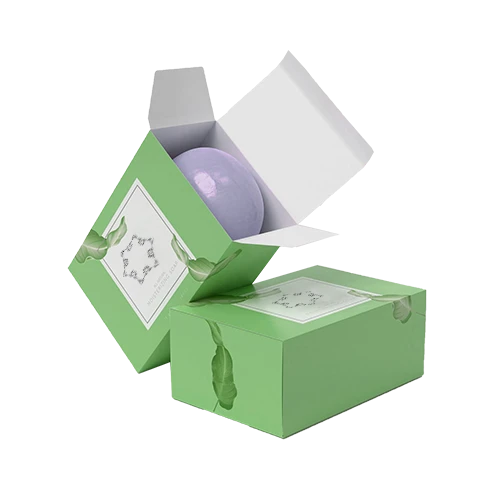
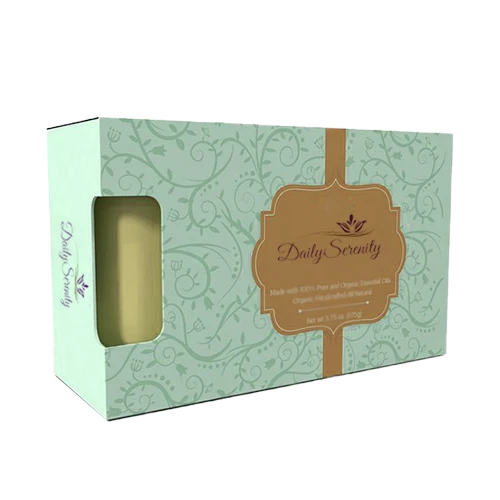
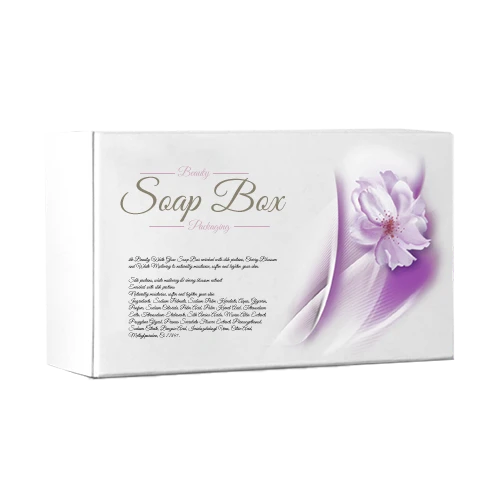
An 18 or 600 gsm board with a matte or soft touch laminate feels more substantial than thin gloss stock for a small per-unit cost difference. Adding branded tissue or kraft inner wrap creates tactile discovery during unboxing and keeps the bar's surface pristine. Q: What types of branded soap packaging options are available?A: Soap packaging typically includes custom printed tuck boxes, sleeves, and cardboard drawer boxes. These types of boxes can be produced in any custom shape and size. In addition, logo embossing, foil stamping, and a wide variety of other finishing options are also available. Q: What stocks options are available for producing custom soap packaging?A: Soap packaging is generally manufactured using coated cardstocks in various thicknesses. In addition, recyclable textured and kraft cardstocks can also be utilized to meet your specific requirements. Q: What is the purpose of adding a window cut-out on soap packaging?A: It may be a good idea to incorporate a window cut-out to your soap packaging design in order to allow customers to see and smell the enclosed soap products without damaging the packaging. The window cut-out can be placed on any box panel and can be customised to any shape and size to fit your specific requirements. |